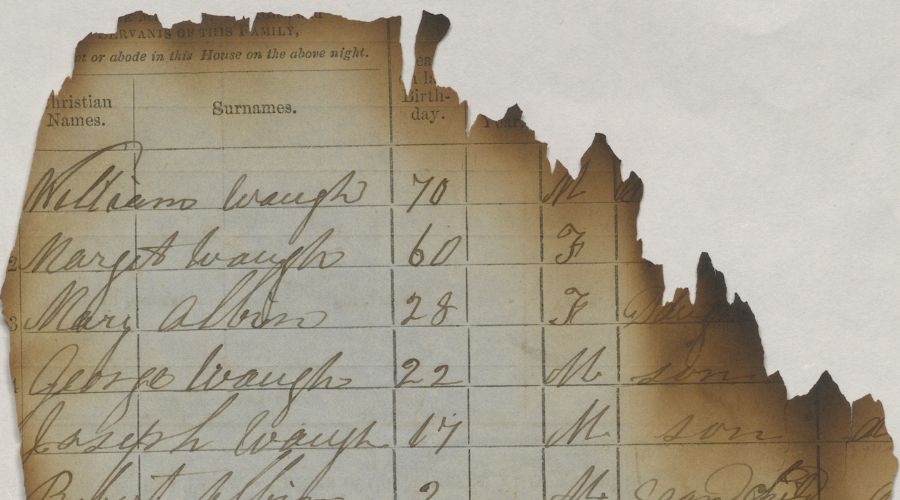
A new guide offers practical advice on locating surviving fragments and copies of the 19th-century census returns lost in the 1922 Four Courts fire.
Accredited Genealogists Ireland (AGI) has published its sixth free guide in its Irish census record series. The latest instalment focuses on the Virtual Record Treasury of Ireland (VRTI), which was launched in 2022 to mark the centenary of the destruction of Ireland’s Public Record Office (PRO) during the Civil War. Among the many documents deposited in the PRO were census returns for several of the 19th-century censuses of Ireland, including those for 1813, 1821, 1831, 1841 and 1851. These were largely destroyed in the Four Courts fire in 1922, with the blaze obliterating records that enumerated 23 million people.
YOU MIGHT ALSO LIKE: 175,000 historical records released online on 103rd anniversary of Public Record Office fire
The ambitious VRTI project is seeking out surviving fragments of these lost census returns as well as copies, abstracts and substitute manuscripts, publications and datasets that replicate parts of the collection that were destroyed. With support from the National Library of Ireland, National Archives of Ireland, Public Record Office of Northern Ireland, Irish Manuscripts Commission, British National Archives, British Library and other repositories across Ireland and around the world, these materials are being digitized and made accessible on the VRTI website.
Although the virtual collection does not represent the entirety of what was destroyed, it may nonetheless allow some researchers to identify ancestors among the surviving records that have come to light in various forms. For example, a complete copy of the 1831 census for Co. Derry was made by the Ordnance Survey of Ireland, while 19th- and early 20th-century genealogists created abstracts of census returns that are preserved in their notebooks and papers.
The AGI guide, “Census Returns in the Virtual Treasury”, outlines the material that has been recovered by the VRTI team led by historic census expert Dr Brian Gurrin. It also explains how to navigate the collection and provides guidance on different methods for searching the VRTI.
The full guide is available to download free of charge here. The VRTI website can be accessed here.
Other guides by AGI
The first instalment in the AGI census series provides an overview of Ireland’s censuses from 1813 to 1926 and is available for free download here. The second instalment sets out what researchers can expect to find in the 1901 census and is available for free download here. Similarly, the third instalment explains what can be found in the 1911 census and how it differs from the previous census; it’s free to download here. The fourth guide looks beyond the household form and highlights the information contained in lesser-known census forms. It can be downloaded free of charge here. The fifth guide examines the socio-political forces that shaped the 1901 and 1911 census returns and can be downloaded here.
A F F I L I A T E A D

Who are AGI?
Accredited Genealogists Ireland (AGI) is the accrediting and representative body for professional genealogists on the island of Ireland. Its members, who carry out private research for clients worldwide, are recognized as leading experts in the field and contribute widely as advocates, authors, lecturers and media contributors within the genealogical community. All adhere to the AGI code of practice. For further information, visit their website accreditedgenealogists.ie.
Advertising Disclaimer: This article contains affiliate links. Irish Heritage News is an affiliate of FindMyPast. We may earn commissions from qualifying purchases – this does not affect the amount you pay for your purchase.
READ NOW
➤ AGI releases more free guides to Ireland’s censuses
➤ New guide to Ireland’s 1901 census available for free download
➤ Expert guide to Irish census records available for free download ahead of 1926 census release
➤ New free resource highlights the social, cultural and political context of Ireland’s census records
➤ Virtual Treasury adds 194,000 more records, taking total past half a million