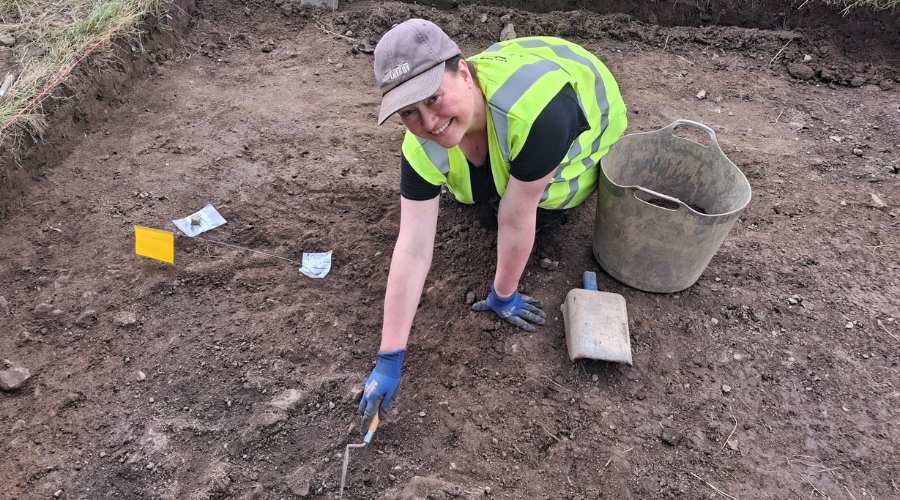
A small team of archaeologists is excavating a major structure at Woodstown, Co. Waterford, which may prove to be the largest Viking building ever discovered in Ireland.
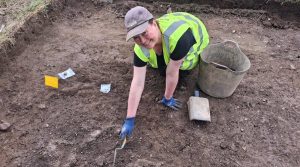
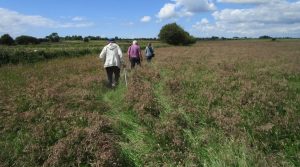
A targeted research excavation in a field on the banks of the River Suir, in Woodstown townland on the outskirts of Waterford city, is yielding new insight into one of the country’s most intriguing Viking settlements.
The excavation is being carried out by Irish and Norwegian archaeologists as part of a joint project between the Archaeological Museum at the University of Stavanger in Norway, the Discovery Programme, Abarta Heritage and Waterford City and County Council. The project is funded by the Royal Irish Academy.
The excavation is focused on a large structure – within a substantial Viking Age settlement site – that archaeologists believe could be the remains of a Viking longhouse or a great hall. At 18.5m long, it may be the largest Viking building recorded in Ireland and further demonstrates the importance of Woodstown as a centre of settlement, trade and craft during the early medieval period, rather than simply a base for raiding.
Woodstown is believed to have been established by Vikings from Norway, possibly Rogaland, in around the 9th century. Archaeologists say discoveries from the site show links between Ireland and this part of Norway during the Viking Age.
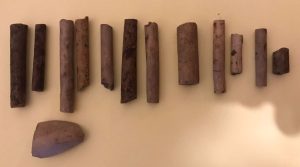
The excavation currently underway at Woodstown has yielded objects associated with trade, metalworking and possibly glassworking. Finds include lead weights used for measuring silver, along with crucibles, iron, slag, nails, rivets, a small gaming piece, a belt strap, a silver coin probably from Iraq and pieces of lignite (jet) bracelets, as well as lots of charcoal and bone which should help with dating the site.
>>> YOU MIGHT ALSO LIKE: Navan’s unusual horse grave and the pagan Viking horse cult
Another interesting discovery were pieces of vessels made from soapstone. This material was commonly used in Norway for cooking pots because it can withstand high temperatures. Soapstone does not occur in Ireland, so it must have been brought to Woodstown by the Vikings.
Other artefacts confirm raiding of Irish church sites was being carried out by those occupying Woodstown. One such object is a fragment of copper alloy or bronze bearing a cross.
Abarta Heritage archaeologist and co-director of the dig Neil Jackman said the artefacts reinforced the idea that these Vikings were both traders and raiders.
Woodstown was first discovered in 2003 during archaeological investigations ahead of the construction of the N25 Waterford city bypass. Only a small section of the site was excavated at the time as part of test excavations and some survey work was also carried out. The discovery of the extensive settlement at Woodstown led to the road route being changed in order to protect the site.
More recently, geophysical surveys and other non-invasive techniques have identified more than 600 archaeological features beneath the surface, including postholes, hearths and other evidence of buildings. These gave archaeologists a much clearer understanding of the site and helped guide where to place excavation trenches.
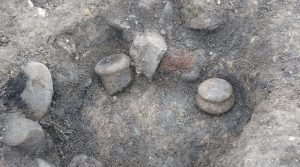
The current excavation is focused on the foundations of the large structure at the heart of the site, with archaeologists examining stake poles and postholes that may reveal how the building was built.
The large structure has now been partially excavated, revealing part of the original floor surface. Jackman has confirmed that double rows of stake holes have been identified, suggesting post-and-wattle construction. Early indications suggest the house may have been destroyed by fire, although the research team does not know whether this was accidental, caused by an act of violence or part of the building’s deliberate abandonment.
Prehistoric activity has also been identified at the site.

Unlike Viking settlements that developed into later towns, including the cities of Waterford and Dublin, Woodstown was abandoned and never became a modern urban centre. This has allowed much of the site to survive below ground with limited disturbance from later development. The site is therefore a rare opportunity to study a fossilized Viking settlement.
Public tours of the site took place at the weekend, giving visitors the opportunity to see an active archaeological excavation first-hand.
>>> YOU MIGHT ALSO LIKE: Waterford jockey Joe Widger’s historic Grand National win at Aintree with Wild Man
The excavation will continue until tomorrow, 19 June, before the site is backfilled.
The research team hopes to carry out further surveys and research excavations in the future and, eventually, perhaps reconstruct parts of the site for educational purposes. The site is highly accessible, lying close to the Waterford Greenway and would make an ideal visitor attraction, just a stone’s throw from Waterford city.
READ NOW
➤ Mass grave in Pennsylvania could contain remains of over 100 Irish railroad workers
➤ Excavation of Sligo’s Green Fort yields over 1,000 finds from 17th-century bastioned military fort
➤ First intact Roman pot found in Ireland at Iron Age site during excavation on Dublin headland
➤ Ballymacombs More Woman: Iron Age bog body found near Bellaghy now identified as young female
➤ New Geneva: Waterford’s failed town that became a prison for rebels