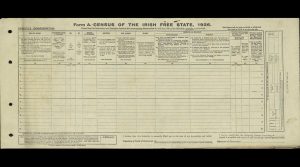
With the release of the 1926 census scheduled for 18 April, Accredited Genealogists Ireland has published further instalments in its ongoing series of census guides.
Late last year, Accredited Genealogists Ireland (AGI) released two additional free publications in its Irish census records series: “1911 Census of Ireland: a guide for family history researchers” and “Beyond Form A: unlocking the hidden depths of the Irish census“.
The 1911 census is the last complete census taken before Irish independence, making it the final census to cover the entire island of Ireland. It was enumerated on 2 April 1911, almost exactly a decade after the 1901 census. No census was taken in 1921 due to the War of Independence and the next census did not take place until 1926.
“The 1911 census is invaluable for genealogists”, said Michael Walsh, President of AGI. “It captures Irish life at a defining moment in our history – the eve of independence”.
AGI’s new guide to the 1911 census outlines the range of information available in its records, including names, ages, occupations, religion, literacy, Irish language ability and housing details. This census also introduced new questions requiring married women to record the duration of their marriage, the total number of children born alive and how many were still living. The 1911 census, therefore, offers unprecedented insight into Irish family structures and child mortality in early 20th-century Ireland.
The guide outlines the impact of the Old Age Pensions Act on the ages recorded in the 1911 census and provides guidance on using wild cards when searching. This new guide is available to download free of charge here.
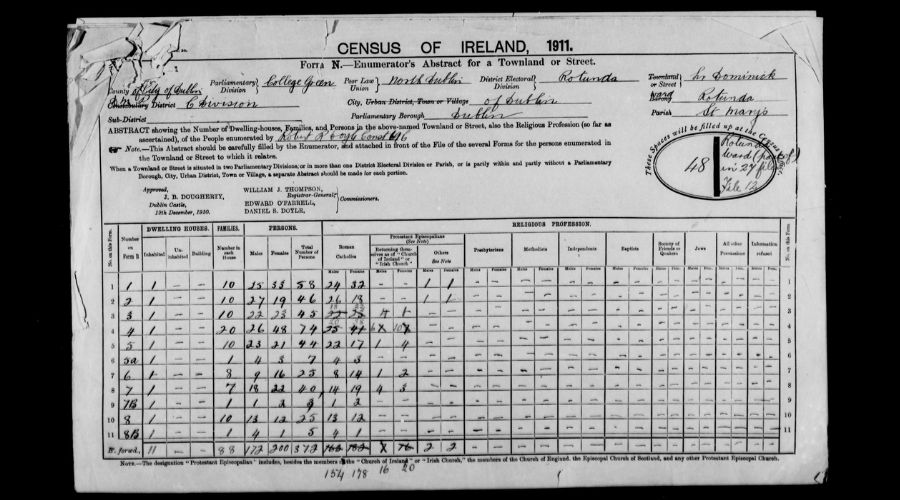
The other recently released guide by AGI, “Beyond Form A “, draws attention to the wealth of information contained in lesser-known census forms that are often overlooked. It directs researchers to forms that reveal not only who lived in Ireland in 1901 and 1911, but how they lived. While most people searching the Irish censuses focus on Form A – the household return listing names, ages, occupations and other personal details – AGI’s guide emphasizes the value of Forms B1, B2 and N. Completed by enumerators, these recorded building types and materials, the number of rooms and windows, and the presence of farm outbuildings such as stables, dairies and piggeries.
A F F I L I A T E A D

The guide includes a striking example from 1 Dominick Street Lower in Dublin, where census forms show that 10 families, comprising 58 people, lived in a 15-room building in 1911, with each family occupying only one or two rooms. This reflects the conditions faced by more than 20,000 Dublin families who were living in just one room at that time.
The guide also examines special census forms relating to people living outside the traditional family homes in institutions like workhouses, hospitals, barracks, schools, asylums, prisons and ships. The people living in these places often prove difficult to track down in the historical record. Depending on the form, some use initials only and not full names.
This new guide is available to download free of charge here.
Other guides
The very first instalment in AGI’s series on Irish censuses was released last summer: “Introduction to the Irish census: a guide for family history researchers”. It provides an overview of Ireland’s censuses from 1813 to 1926 and is available for free download here. Their second instalment “1901 Census of Ireland: a guide for family history researchers”, sets out what you can expect to find in the 1901 census and is available for free download here.
The 1901 and 1911 censuses can be searched for free online through the National Archives of Ireland website here.
Who are AGI?
Accredited Genealogists Ireland (AGI) is the accrediting and representative body for professional genealogists on the island of Ireland. Its members, who carry out private research for clients worldwide, are recognized as leading experts in the field and contribute widely as advocates, authors, lecturers and media contributors within the genealogical community. All adhere to the AGI code of practice. For further information, visit their website accreditedgenealogists.ie.
Advertising Disclaimer: This article contains affiliate links. Irish Heritage News is an affiliate of FindMyPast. We may earn commissions from qualifying purchases – this does not affect the amount you pay for your purchase.
READ NOW
➤ New guide to Ireland’s 1901 census available for free download
➤ Expert guide to Irish census records available for free download ahead of 1926 census release
➤ CSO releases 1926 census data on occupations
➤ A closer look at the public programme for the 1926 census release